

Article Sidebar
Main Article Content
Abstract
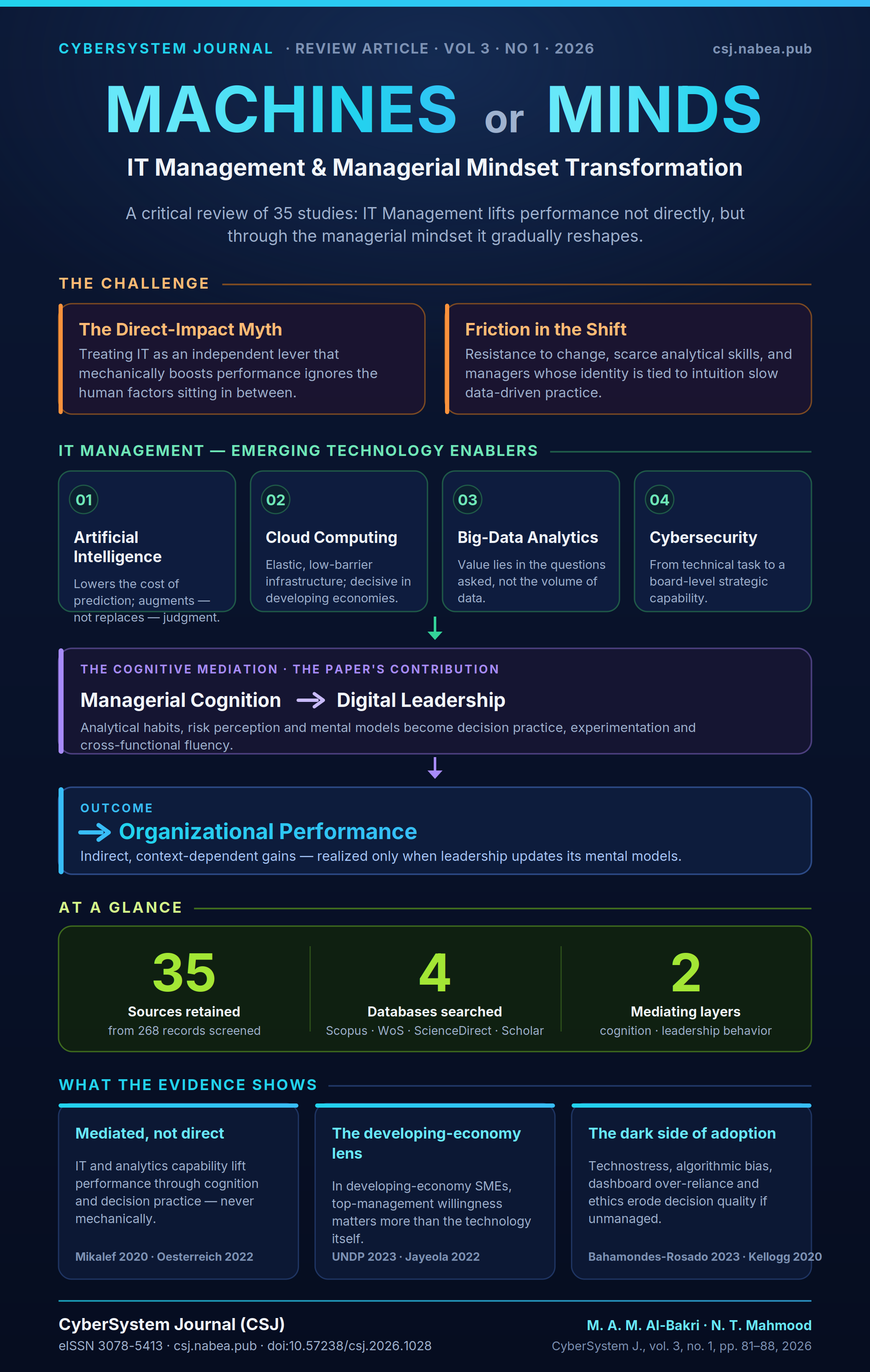
Purpose: This subject review investigates how Information Technology (IT) Management contributes to reshaping the managerial mindset within contemporary organizations, with particular attention to decision-making behavior, cognitive adaptation, and the mediating role of human factors between technology adoption and organizational performance.Design and Approach: A descriptive-analytical literature review was conducted on peer-reviewed publications retrieved from Scopus, Web of Science, Science Direct, and Google Scholar, covering the period from 2020 to 2025, with a small number of seminal earlier works retained where conceptually indispensable. Thirty-five sources were retained for in-depth analysis after applying inclusion and exclusion criteria, including topical relevance, methodological transparency, and publication in indexed journals or recognized academic presses.Findings: The review indicates that IT Management has shifted from a supportive operational function to a strategic cognitive enabler. Its influence on organizational performance is rarely direct; rather, it is mediated by managerial cognition, organizational culture, and digital readiness. Emerging technologies artificial intelligence, cloud computing, big-data analytics, and cybersecurity frameworks amplify this mediating effect but also introduce technostress, algorithmic bias, and ethical concerns.Originality: The study proposes an integrated conceptual framework that positions managerial mindset as a cognitive intermediary between IT capabilities and performance outcomes, with explicit attention to developing-country contexts that remain underrepresented in mainstream IS literature.
Keywords
Article Details
Copyright (c) 2026 Noor Thamer, Mustafa Adnan Madloul Al-Bakri (Author)

This work is licensed under a Creative Commons Attribution 4.0 International License.
How to Cite


References
- Machines: The Simple Economics of Artificial Intelligence”, (Updated and expanded ed.). Boston, MA: Harvard Business Review Press, 2022. ISBN: 978-1-647824679
- M. E. Bahamondes-Rosado, L. M. Cerdá-Suárez, G. F. Dodero Ortiz de Zevallos, and J. F. Espinosa-Cristia, “Technostress at work during the COVID-19 lockdown phase (2020–2021): A systematic review of the literature,”, Frontiers in Psychology, vol. 14, p. 1173425, 2023. DOI: https://doi.org/10.3389/fpsyg.2023.1173425
- L. Espina-Romero, J. G. Noroño Sánchez, G. Rojas-Cangahuala, J. P. Palacios Garay, D. Ríos Parra, and J. Rio Corredoira, “Digital leadership: A systematic literature review,”, Administrative Sciences, vol. 15, no. 4, p. 129, 2025. DOI: https://doi.org/10.3390/admsci15040129
- A. Hanelt, R. Bohnsack, D. Marz, and C. Antunes Marante, “A systematic review of the literature on digital transformation: Insights and implications for strategy and organizational change,”, Journal of Management Studies, vol. 58, no. 5, pp. 1159–1197, 2021. DOI: https://doi.org/10.1111/joms.12639
- Z. K. Jassim and F. R. Algazali, “Digital transformation and its impact on achieving high performance for public sector organizations in Iraq,”, Al-Ghary Journal of Economic and Administrative Sciences, vol. 20, no. special issue, pp. 1433–1456, 2024. DOI: https://doi.org/10.36325/ghjec.v20i00.17024
- O. Jayeola, S. Sidek, A. Abd Rahman, A. S. B. Mahomed, and J. Hu, “Cloud computing adoption in small and medium enterprises (SMEs): A systematic literature review and directions for future research,”, International Journal of Business and Society, vol. 23, no. 1, pp. 226–243, 2022. DOI: https://doi.org/10.33736/ijbs.4610.2022 [Corrected DOI]
- K. C. Kellogg, M. A. Valentine, and A. Christin, “Algorithms at work: The new contested terrain of control,”, Academy of Management Annals, vol. 14, no. 1, pp. 366–410, 2020. DOI: https://doi.org/10.5465/annals.2018.0174
- A. Khayer, M. S. Talukder, Y. Bao, and M. N. Hossain, “Cloud computing adoption and its impact on SMEs’ performance for cloud-supported operations: A dual-stage analytical approach,”, Technology in Society, vol. 60, p. 101225, 2020. DOI: https://doi.org/10.1016/j.techsoc.2019.101225
- S. Kraus, M. Breier, and S. Dasí-Rodríguez, “The art of crafting a systematic literature review in entrepreneurship research,”, International Entrepreneurship and Management Journal, vol. 16, pp. 1023–1042, 2020. DOI: https://doi.org/10.1007/s11365-020-00635-4
- N. Kshetri, “The economics of cyberattacks on small and medium-sized enterprises,”, Computer, vol. 54, no. 8, pp. 41–47, Aug. 2021. DOI: https://doi.org/10.1109/MC.2021.3080045
- E. Marsh, E. P. Vallejos, and A. Spence, “Integrating and synthesising technostress research: A meta-analysis on technostress creators, outcomes, and IS usage contexts,”, European Journal of Information Systems, vol. 33, no. 3, pp. 361–382, 2024. DOI: https://doi.org/10.1080/0960085X.2022.2154712
- P. Maroufkhani, M. Iranmanesh, and M. Ghobakhloo, “Determinants of big data analytics adoption in small and medium-sized enterprises (SMEs),”, Industrial Management & Data Systems, vol. 123, no. 1, pp. 278–301, 2023. DOI: https://doi.org/10.1108/IMDS-11-2021-0695
- P. Mikalef, I. O. Pappas, J. Krogstie, and P. A. Pavlou, “Big data and business analytics: A research agenda for realizing business value,”, Information & Management, vol. 57, no. 1, p. 103237, 2020. DOI: https://doi.org/10.1016/j.im.2019.103237
- F. Mizrak, “Integrating cybersecurity risk management into strategic management: A comprehensive literature review,”, Research Journal of Business and Management, vol. 10, no. 3, pp. 98–108, 2023. DOI: https://doi.org/10.17261/Pressacademia.2023.1807
- R. Mulyana, L. Rusu, and E. Perjons, “IT governance mechanisms influence on digital transformation: A systematic literature review,”, in Proc. 30th Americas Conf. Inf. Syst. (AMCIS 2024), Salt Lake City, UT, 2024.
- H. Nayernia, H. Bahemia, and S. Papagiannidis, “A systematic review of the implementation of industry 4.0 from the organisational perspective,”, International Journal of Production Research, vol. 60, no. 14, pp. 4365–4396, 2022. DOI: https://doi.org/10.1080/00207543.2021.2002964
- T. D. Oesterreich, E. Anton, F. Teuteberg, and Y. K. Dwivedi, “The role of the social and technical factors in creating business value from big data analytics: A meta-analysis,”, Journal of Business Research, vol. 153, pp. 128–149, 2022. DOI: https://doi.org/10.1016/j.jbusres.2022.08.028
- J. Paul, W. M. Lim, A. O’Cass, A. W. Hao, and S. Bresciani, “Scientific procedures and rationales for systematic literature reviews (SPAR-4-SLR),”, International Journal of Consumer Studies, vol. 45, no. 4, pp. O1–O16, 2021. DOI: https://doi.org/10.1111/ijcs.12695
- Y. R. Shrestha, V. Krishna, and G. von Krogh, “Augmenting organizational decision-making with deep learning algorithms: Principles, promises, and challenges,”, Journal of Business Research, vol. 123, pp. 588–603, 2021. DOI: https://doi.org/10.1016/j.jbusres.2020.09.068
- S. Slapničar, T. Vuko, M. Čular, and M. Drašček, “Cyber risk management: An illusion of a risk-based approach,”, Journal of Management Control, vol. 36, pp. 1–32, 2025. DOI: https://doi.org/10.1007/s00187-025-00401-z
- F. B. Tigre, C. Curado, and P. L. Henriques, “Digital leadership: A bibliometric analysis,”, Journal of Leadership & Organizational Studies, vol. 30, no. 1, pp. 40–70, 2023. DOI: https://doi.org/10.1177/15480518221123132
- F. B. Tigre, P. L. Henriques, and C. Curado, “The digital leadership emerging construct: A multi-method approach,”, Management Review Quarterly, vol. 74, pp. 1–35, 2024. DOI: https://doi.org/10.1007/s11301-023-00395-9
- C. Trocin, P. Mikalef, Z. Papamitsiou, and K. Conboy, “Responsible AI for digital health: A synthesis and a research agenda,”, Information Systems Frontiers, vol. 25, pp. 2139–2157, 2023. DOI: https://doi.org/10.1007/s10796-021-10146-4
- UNDP, “Digital Landscape Assessment of Iraq.”, United Nations Development Programme, Iraq Country Office, 2023.
- S. Vejseli, A. Rossmann, and K. Garidis, “The concept of agility in IT governance and its impact on firm performance,”, in Proc. 30th European Conf. Inf. Syst. (ECIS 2022), Timişoara, Romania, 2022, Research Paper 98.
- P. C. Verhoef, T. Broekhuizen, Y. Bart, A. Bhattacharya, J. Q. Dong, N. Fabian, and M. Haenlein, “Digital transformation: A multidisciplinary reflection and research agenda,”, Journal of Business Research, vol. 122, pp. 889–901, 2021.DOI:https://doi.org/10.1016/j.jbusres.2019.09.022
- R. Vidgen, G. Hindle, and I. Randolph, “Exploring the ethical implications of business analytics with a business ethics canvas,”, European Journal of Operational Research, vol. 281, no. 3, pp. 491–501, 2020. DOI: https://doi.org/10.1016/j.ejor.2019.04.036
- S. F. Wamba, M. M. Queiroz, C. J. C. Jabbour, and C. V. Shi, “Are both generative AI and ChatGPT game changers for 21st-century operations and supply chain excellence?”, International Journal of Production Economics, vol. 265, p. 109015, 2023. DOI: https://doi.org/10.1016/j.ijpe.2023.109015
References
Machines: The Simple Economics of Artificial Intelligence”, (Updated and expanded ed.). Boston, MA: Harvard Business Review Press, 2022. ISBN: 978-1-647824679
M. E. Bahamondes-Rosado, L. M. Cerdá-Suárez, G. F. Dodero Ortiz de Zevallos, and J. F. Espinosa-Cristia, “Technostress at work during the COVID-19 lockdown phase (2020–2021): A systematic review of the literature,”, Frontiers in Psychology, vol. 14, p. 1173425, 2023. DOI: https://doi.org/10.3389/fpsyg.2023.1173425
L. Espina-Romero, J. G. Noroño Sánchez, G. Rojas-Cangahuala, J. P. Palacios Garay, D. Ríos Parra, and J. Rio Corredoira, “Digital leadership: A systematic literature review,”, Administrative Sciences, vol. 15, no. 4, p. 129, 2025. DOI: https://doi.org/10.3390/admsci15040129
A. Hanelt, R. Bohnsack, D. Marz, and C. Antunes Marante, “A systematic review of the literature on digital transformation: Insights and implications for strategy and organizational change,”, Journal of Management Studies, vol. 58, no. 5, pp. 1159–1197, 2021. DOI: https://doi.org/10.1111/joms.12639
Z. K. Jassim and F. R. Algazali, “Digital transformation and its impact on achieving high performance for public sector organizations in Iraq,”, Al-Ghary Journal of Economic and Administrative Sciences, vol. 20, no. special issue, pp. 1433–1456, 2024. DOI: https://doi.org/10.36325/ghjec.v20i00.17024
O. Jayeola, S. Sidek, A. Abd Rahman, A. S. B. Mahomed, and J. Hu, “Cloud computing adoption in small and medium enterprises (SMEs): A systematic literature review and directions for future research,”, International Journal of Business and Society, vol. 23, no. 1, pp. 226–243, 2022. DOI: https://doi.org/10.33736/ijbs.4610.2022 [Corrected DOI]
K. C. Kellogg, M. A. Valentine, and A. Christin, “Algorithms at work: The new contested terrain of control,”, Academy of Management Annals, vol. 14, no. 1, pp. 366–410, 2020. DOI: https://doi.org/10.5465/annals.2018.0174
A. Khayer, M. S. Talukder, Y. Bao, and M. N. Hossain, “Cloud computing adoption and its impact on SMEs’ performance for cloud-supported operations: A dual-stage analytical approach,”, Technology in Society, vol. 60, p. 101225, 2020. DOI: https://doi.org/10.1016/j.techsoc.2019.101225
S. Kraus, M. Breier, and S. Dasí-Rodríguez, “The art of crafting a systematic literature review in entrepreneurship research,”, International Entrepreneurship and Management Journal, vol. 16, pp. 1023–1042, 2020. DOI: https://doi.org/10.1007/s11365-020-00635-4
N. Kshetri, “The economics of cyberattacks on small and medium-sized enterprises,”, Computer, vol. 54, no. 8, pp. 41–47, Aug. 2021. DOI: https://doi.org/10.1109/MC.2021.3080045
E. Marsh, E. P. Vallejos, and A. Spence, “Integrating and synthesising technostress research: A meta-analysis on technostress creators, outcomes, and IS usage contexts,”, European Journal of Information Systems, vol. 33, no. 3, pp. 361–382, 2024. DOI: https://doi.org/10.1080/0960085X.2022.2154712
P. Maroufkhani, M. Iranmanesh, and M. Ghobakhloo, “Determinants of big data analytics adoption in small and medium-sized enterprises (SMEs),”, Industrial Management & Data Systems, vol. 123, no. 1, pp. 278–301, 2023. DOI: https://doi.org/10.1108/IMDS-11-2021-0695
P. Mikalef, I. O. Pappas, J. Krogstie, and P. A. Pavlou, “Big data and business analytics: A research agenda for realizing business value,”, Information & Management, vol. 57, no. 1, p. 103237, 2020. DOI: https://doi.org/10.1016/j.im.2019.103237
F. Mizrak, “Integrating cybersecurity risk management into strategic management: A comprehensive literature review,”, Research Journal of Business and Management, vol. 10, no. 3, pp. 98–108, 2023. DOI: https://doi.org/10.17261/Pressacademia.2023.1807
R. Mulyana, L. Rusu, and E. Perjons, “IT governance mechanisms influence on digital transformation: A systematic literature review,”, in Proc. 30th Americas Conf. Inf. Syst. (AMCIS 2024), Salt Lake City, UT, 2024.
H. Nayernia, H. Bahemia, and S. Papagiannidis, “A systematic review of the implementation of industry 4.0 from the organisational perspective,”, International Journal of Production Research, vol. 60, no. 14, pp. 4365–4396, 2022. DOI: https://doi.org/10.1080/00207543.2021.2002964
T. D. Oesterreich, E. Anton, F. Teuteberg, and Y. K. Dwivedi, “The role of the social and technical factors in creating business value from big data analytics: A meta-analysis,”, Journal of Business Research, vol. 153, pp. 128–149, 2022. DOI: https://doi.org/10.1016/j.jbusres.2022.08.028
J. Paul, W. M. Lim, A. O’Cass, A. W. Hao, and S. Bresciani, “Scientific procedures and rationales for systematic literature reviews (SPAR-4-SLR),”, International Journal of Consumer Studies, vol. 45, no. 4, pp. O1–O16, 2021. DOI: https://doi.org/10.1111/ijcs.12695
Y. R. Shrestha, V. Krishna, and G. von Krogh, “Augmenting organizational decision-making with deep learning algorithms: Principles, promises, and challenges,”, Journal of Business Research, vol. 123, pp. 588–603, 2021. DOI: https://doi.org/10.1016/j.jbusres.2020.09.068
S. Slapničar, T. Vuko, M. Čular, and M. Drašček, “Cyber risk management: An illusion of a risk-based approach,”, Journal of Management Control, vol. 36, pp. 1–32, 2025. DOI: https://doi.org/10.1007/s00187-025-00401-z
F. B. Tigre, C. Curado, and P. L. Henriques, “Digital leadership: A bibliometric analysis,”, Journal of Leadership & Organizational Studies, vol. 30, no. 1, pp. 40–70, 2023. DOI: https://doi.org/10.1177/15480518221123132
F. B. Tigre, P. L. Henriques, and C. Curado, “The digital leadership emerging construct: A multi-method approach,”, Management Review Quarterly, vol. 74, pp. 1–35, 2024. DOI: https://doi.org/10.1007/s11301-023-00395-9
C. Trocin, P. Mikalef, Z. Papamitsiou, and K. Conboy, “Responsible AI for digital health: A synthesis and a research agenda,”, Information Systems Frontiers, vol. 25, pp. 2139–2157, 2023. DOI: https://doi.org/10.1007/s10796-021-10146-4
UNDP, “Digital Landscape Assessment of Iraq.”, United Nations Development Programme, Iraq Country Office, 2023.
S. Vejseli, A. Rossmann, and K. Garidis, “The concept of agility in IT governance and its impact on firm performance,”, in Proc. 30th European Conf. Inf. Syst. (ECIS 2022), Timişoara, Romania, 2022, Research Paper 98.
P. C. Verhoef, T. Broekhuizen, Y. Bart, A. Bhattacharya, J. Q. Dong, N. Fabian, and M. Haenlein, “Digital transformation: A multidisciplinary reflection and research agenda,”, Journal of Business Research, vol. 122, pp. 889–901, 2021.DOI:https://doi.org/10.1016/j.jbusres.2019.09.022
R. Vidgen, G. Hindle, and I. Randolph, “Exploring the ethical implications of business analytics with a business ethics canvas,”, European Journal of Operational Research, vol. 281, no. 3, pp. 491–501, 2020. DOI: https://doi.org/10.1016/j.ejor.2019.04.036
S. F. Wamba, M. M. Queiroz, C. J. C. Jabbour, and C. V. Shi, “Are both generative AI and ChatGPT game changers for 21st-century operations and supply chain excellence?”, International Journal of Production Economics, vol. 265, p. 109015, 2023. DOI: https://doi.org/10.1016/j.ijpe.2023.109015