

Article Sidebar
Main Article Content
Abstract
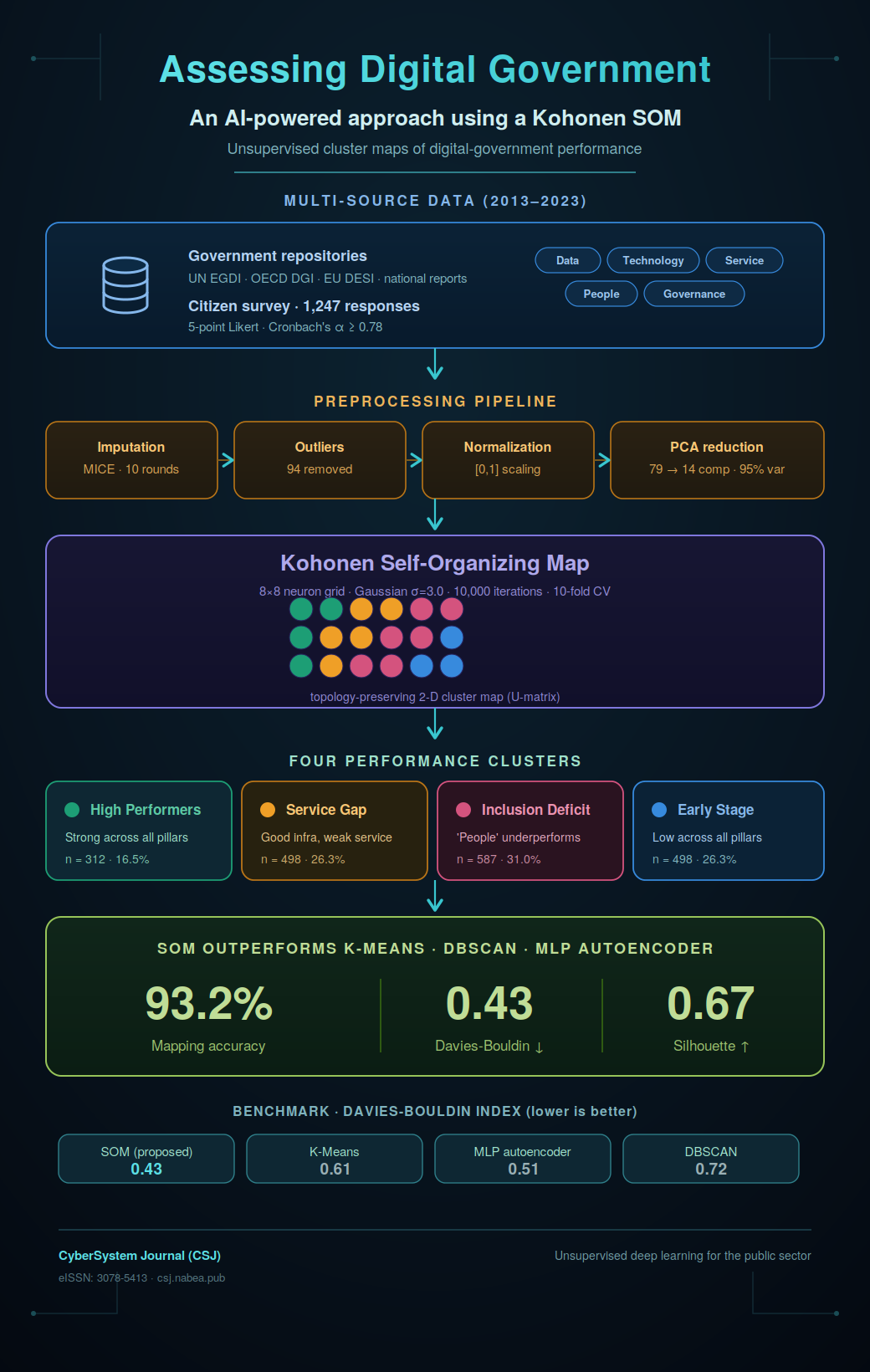
Digital government represents the implementation of information and communication technologies (ICT) in provision of public services, governance process optimization and transparent interaction with citizens. However, despite rapid progress in the field, the comprehensive assessment of digital government maturity and quality is rather challenging due to complex nature of related measures. Existing frameworks for evaluation of digital government—from EGDI of UN to DESI of EU—are based on complex indexation across many metrics, thus rendering comparisons difficult and impeding specific recommendations for improvements. This paper proposes a new AI-based approach to digital government assessment and benchmarking based on use of Kohonen Self-Organizing Map (SOM) neural network and focused on the generation of comprehensible cluster maps of digital government performance at national and sub-national level. Data set comprising information over ten-year period was gathered from government repositories and supplemented by public survey with five major dimensions addressed: Data, Technology, Service, People, and Governance. Preprocessing of the data included an elaborate preprocessing pipeline involving the use of imputation, elimination of outliers, data normalization, and principal component analysis for dimensionality reduction before modeling could be undertaken. The results from this process showed four groups of performance, each with built-in outlier detection. Validation of results was achieved using ten-fold cross-validation. The technique proved more effective and accurate than conventional techniques like K-means and DBSCAN and multilayer perceptrons, as indicated by a Davies-Bouldin index value of 0.43 and an accuracy of 93.2%. These results suggest that unsupervised deep learning can be effectively employed as a tool by policymakers and digital government administrators.
Keywords
Article Details
Copyright (c) 2026 Zaid Ibrahim Rasool (Author)

This work is licensed under a Creative Commons Attribution 4.0 International License.
How to Cite


References
- J. Fedorowicz, S. Sawyer, and A. Tomasino, "Governance configurations for inter-organizational coordination: A study of public safety networks," J. Inf. Technol., vol. 33, no. 4, pp. 326–344, 2018, doi: 10.1057/s41265-018-0056-z
- V. S. Tynchenko and V. V. Kukartsev, "Application of Kohonen self-organizing maps to the analysis of enterprises' employees certification results," IOP Conf. Ser.: Mater. Sci. Eng., vol. 537, no. 4, p. 042010, 2019, doi: 10.1088/1757-899X/537/4/042010
- E. O. Borshchevskaia, "E-Government Development Index: Dynamics of the world and Russia's position," in Proc. 18th PCSF, Eur. Proc. Soc. Behav. Sci., 2018, doi: 10.15405/epsbs.2018.12.02.163
- R. A. Kamble, "Short and long term stock trend prediction using decision tree," in Proc. Int. Conf. Intell. Comput. Control Syst. (ICICCS), Madurai, India, pp. 1371–1375, 2017, doi: 10.1109/ICCONS.2017.8250694
- P. Chandrasekar and K. Qian, "The impact of data preprocessing on the performance of a Naive Bayes classifier," in Proc. IEEE 40th Annu. Comput. Softw. Appl. Conf. (COMPSAC), Atlanta, GA, USA, vol. 2, pp. 618–619, 2016, doi: 10.1109/COMPSAC.2016.205
- A. Asok, "Generalized approach to linear data transformation," in Proc. Int. Conf. Data Sci. Eng. (ICDSE), Cochin, India, 2016, doi: 10.1109/ICDSE.2016.7823937
- E. A. Villaseñor, R. Arencibia-Jorge, and H. Carrillo-Calvet, "Multiparametric characterization of scientometric performance profiles assisted by neural networks: A study of Mexican higher education institutions," Scientometrics, vol. 110, no. 1, pp. 77–104, 2017, doi: 10.1007/s11192-016-2166-0
- OECD and IDB, Broadband Policies for Latin America and the Caribbean: A Digital Economy Toolkit. Paris: OECD Publishing, 2016, doi: 10.1787/9789264251823-en
- OECD, Education at a Glance 2014: OECD Indicators. Paris: OECD Publishing, 2014, doi: 10.1787/eag-2014-en
- D. E. Luna, J. R. Gil-Garcia, L. F. Luna-Reyes, R. Sandoval-Almazan, and A. Duarte-Valle, "Improving the performance assessment of government web portals: A proposal using data envelopment analysis (DEA)," Inf. Polity, vol. 18, no. 2, pp. 169–187, 2013, doi: 10.3233/IP-130302
- L. F. Luna-Reyes and S. Mellouli, "Key factors and processes for digital government success," Inf. Polity, vol. 18, no. 2, pp. 101–105, 2013, doi: 10.3233/IP-130307
- S. P. Robertson and R. K. Vatrapu, "Digital government," Annu. Rev. Inf. Sci. Technol., vol. 44, no. 1, pp. 317–364, 2010, doi: 10.1002/aris.2010.1440440115
- G. Puron-Cid, "Los efectos de las características tecnológicas en los sitios web del gobierno: Un análisis longitudinal de los gobiernos estatales en los Estados Unidos (2001–2006)," CIDE, Mexico City, Documento de Trabajo No. 263, 2011.
- J. C. Bertot, "Community-based e-government: Libraries as e-government partners and providers," in Proc. Electronic Government (EGOV 2010), Lecture Notes in Computer Science, vol. 6228, pp. 121–131, 2010.
- T. Kohonen, Self-Organizing Maps, 3rd ed. Berlin, Germany: Springer, 2001.
- H. Margetts and P. Dunleavy, "The second wave of digital-era governance: A quasi-paradigm for government on the Web," Philos. Trans. R. Soc. A, vol. 371, no. 1987, p. 20120382, 2013, doi: 10.1098/rsta.2012.0382
- Ø. Sæbø, L. S. Flak, and M. K. Sein, "Understanding the dynamics in e-Participation initiatives: Looking through the genre and stakeholder lenses," Gov. Inf. Q., vol. 28, no. 3, pp. 416–425, 2011, doi: 10.1016/j.giq.2010.10.005
- Z. Khan and I. Rana, "Artificial intelligence in e-governance: A framework for developing smart government," Int. J. Adv. Comput. Sci. Appl. (IJACSA), vol. 11, no. 3, pp. 73–79, 2020.
- G. Misuraca and C. van Noordt, AI Watch — Artificial Intelligence in Public Services: Overview of the Use and Impact of AI in Public Services in the EU. Luxembourg: Publications Office of the European Union, 2020.
- C. Zhang and A. Dafoe, "Artificial intelligence: American attitudes and trends," Daedalus, vol. 148, no. 4, pp. 102–123, 2019.
- M. Janssen, M. A. Wimmer, and A. Deljoo, Eds., Policy Practice and Digital Science: Integrating Complex Systems, Social Simulation and Public Administration in Policy Research. Cham, Switzerland: Springer, 2015.
- W. Castelnovo, "A stakeholder based evaluation of public value of e-government services," Gov. Inf. Q., vol. 30, no. 2, pp. 189–198, 2013, doi: 10.1016/j.giq.2012.09.007
- E. Estevez and T. Janowski, "Electronic governance for sustainable development: Conceptual framework and state of research," Gov. Inf. Q., vol. 30, pp. S94–S109, 2013, doi: 10.1016/j.giq.2013.05.001
- S. Alshomrani, "A comparative study on United Nations e-government indicators between Saudi Arabia and USA," J. Emerg. Trends Comput. Inf. Sci., vol. 3, no. 3, pp. 411–420, 2012.
- Y. Zheng and H. L. Schachter, "Explaining citizens' e-participation use: The role of perceived advantages," Public Organ. Rev., vol. 17, no. 3, pp. 409–428, 2017, doi: 10.1007/s11115-016-0346-2
References
J. Fedorowicz, S. Sawyer, and A. Tomasino, "Governance configurations for inter-organizational coordination: A study of public safety networks," J. Inf. Technol., vol. 33, no. 4, pp. 326–344, 2018, doi: 10.1057/s41265-018-0056-z
V. S. Tynchenko and V. V. Kukartsev, "Application of Kohonen self-organizing maps to the analysis of enterprises' employees certification results," IOP Conf. Ser.: Mater. Sci. Eng., vol. 537, no. 4, p. 042010, 2019, doi: 10.1088/1757-899X/537/4/042010
E. O. Borshchevskaia, "E-Government Development Index: Dynamics of the world and Russia's position," in Proc. 18th PCSF, Eur. Proc. Soc. Behav. Sci., 2018, doi: 10.15405/epsbs.2018.12.02.163
R. A. Kamble, "Short and long term stock trend prediction using decision tree," in Proc. Int. Conf. Intell. Comput. Control Syst. (ICICCS), Madurai, India, pp. 1371–1375, 2017, doi: 10.1109/ICCONS.2017.8250694
P. Chandrasekar and K. Qian, "The impact of data preprocessing on the performance of a Naive Bayes classifier," in Proc. IEEE 40th Annu. Comput. Softw. Appl. Conf. (COMPSAC), Atlanta, GA, USA, vol. 2, pp. 618–619, 2016, doi: 10.1109/COMPSAC.2016.205
A. Asok, "Generalized approach to linear data transformation," in Proc. Int. Conf. Data Sci. Eng. (ICDSE), Cochin, India, 2016, doi: 10.1109/ICDSE.2016.7823937
E. A. Villaseñor, R. Arencibia-Jorge, and H. Carrillo-Calvet, "Multiparametric characterization of scientometric performance profiles assisted by neural networks: A study of Mexican higher education institutions," Scientometrics, vol. 110, no. 1, pp. 77–104, 2017, doi: 10.1007/s11192-016-2166-0
OECD and IDB, Broadband Policies for Latin America and the Caribbean: A Digital Economy Toolkit. Paris: OECD Publishing, 2016, doi: 10.1787/9789264251823-en
OECD, Education at a Glance 2014: OECD Indicators. Paris: OECD Publishing, 2014, doi: 10.1787/eag-2014-en
D. E. Luna, J. R. Gil-Garcia, L. F. Luna-Reyes, R. Sandoval-Almazan, and A. Duarte-Valle, "Improving the performance assessment of government web portals: A proposal using data envelopment analysis (DEA)," Inf. Polity, vol. 18, no. 2, pp. 169–187, 2013, doi: 10.3233/IP-130302
L. F. Luna-Reyes and S. Mellouli, "Key factors and processes for digital government success," Inf. Polity, vol. 18, no. 2, pp. 101–105, 2013, doi: 10.3233/IP-130307
S. P. Robertson and R. K. Vatrapu, "Digital government," Annu. Rev. Inf. Sci. Technol., vol. 44, no. 1, pp. 317–364, 2010, doi: 10.1002/aris.2010.1440440115
G. Puron-Cid, "Los efectos de las características tecnológicas en los sitios web del gobierno: Un análisis longitudinal de los gobiernos estatales en los Estados Unidos (2001–2006)," CIDE, Mexico City, Documento de Trabajo No. 263, 2011.
J. C. Bertot, "Community-based e-government: Libraries as e-government partners and providers," in Proc. Electronic Government (EGOV 2010), Lecture Notes in Computer Science, vol. 6228, pp. 121–131, 2010.
T. Kohonen, Self-Organizing Maps, 3rd ed. Berlin, Germany: Springer, 2001.
H. Margetts and P. Dunleavy, "The second wave of digital-era governance: A quasi-paradigm for government on the Web," Philos. Trans. R. Soc. A, vol. 371, no. 1987, p. 20120382, 2013, doi: 10.1098/rsta.2012.0382
Ø. Sæbø, L. S. Flak, and M. K. Sein, "Understanding the dynamics in e-Participation initiatives: Looking through the genre and stakeholder lenses," Gov. Inf. Q., vol. 28, no. 3, pp. 416–425, 2011, doi: 10.1016/j.giq.2010.10.005
Z. Khan and I. Rana, "Artificial intelligence in e-governance: A framework for developing smart government," Int. J. Adv. Comput. Sci. Appl. (IJACSA), vol. 11, no. 3, pp. 73–79, 2020.
G. Misuraca and C. van Noordt, AI Watch — Artificial Intelligence in Public Services: Overview of the Use and Impact of AI in Public Services in the EU. Luxembourg: Publications Office of the European Union, 2020.
C. Zhang and A. Dafoe, "Artificial intelligence: American attitudes and trends," Daedalus, vol. 148, no. 4, pp. 102–123, 2019.
M. Janssen, M. A. Wimmer, and A. Deljoo, Eds., Policy Practice and Digital Science: Integrating Complex Systems, Social Simulation and Public Administration in Policy Research. Cham, Switzerland: Springer, 2015.
W. Castelnovo, "A stakeholder based evaluation of public value of e-government services," Gov. Inf. Q., vol. 30, no. 2, pp. 189–198, 2013, doi: 10.1016/j.giq.2012.09.007
E. Estevez and T. Janowski, "Electronic governance for sustainable development: Conceptual framework and state of research," Gov. Inf. Q., vol. 30, pp. S94–S109, 2013, doi: 10.1016/j.giq.2013.05.001
S. Alshomrani, "A comparative study on United Nations e-government indicators between Saudi Arabia and USA," J. Emerg. Trends Comput. Inf. Sci., vol. 3, no. 3, pp. 411–420, 2012.
Y. Zheng and H. L. Schachter, "Explaining citizens' e-participation use: The role of perceived advantages," Public Organ. Rev., vol. 17, no. 3, pp. 409–428, 2017, doi: 10.1007/s11115-016-0346-2