

Article Sidebar
Main Article Content
Abstract
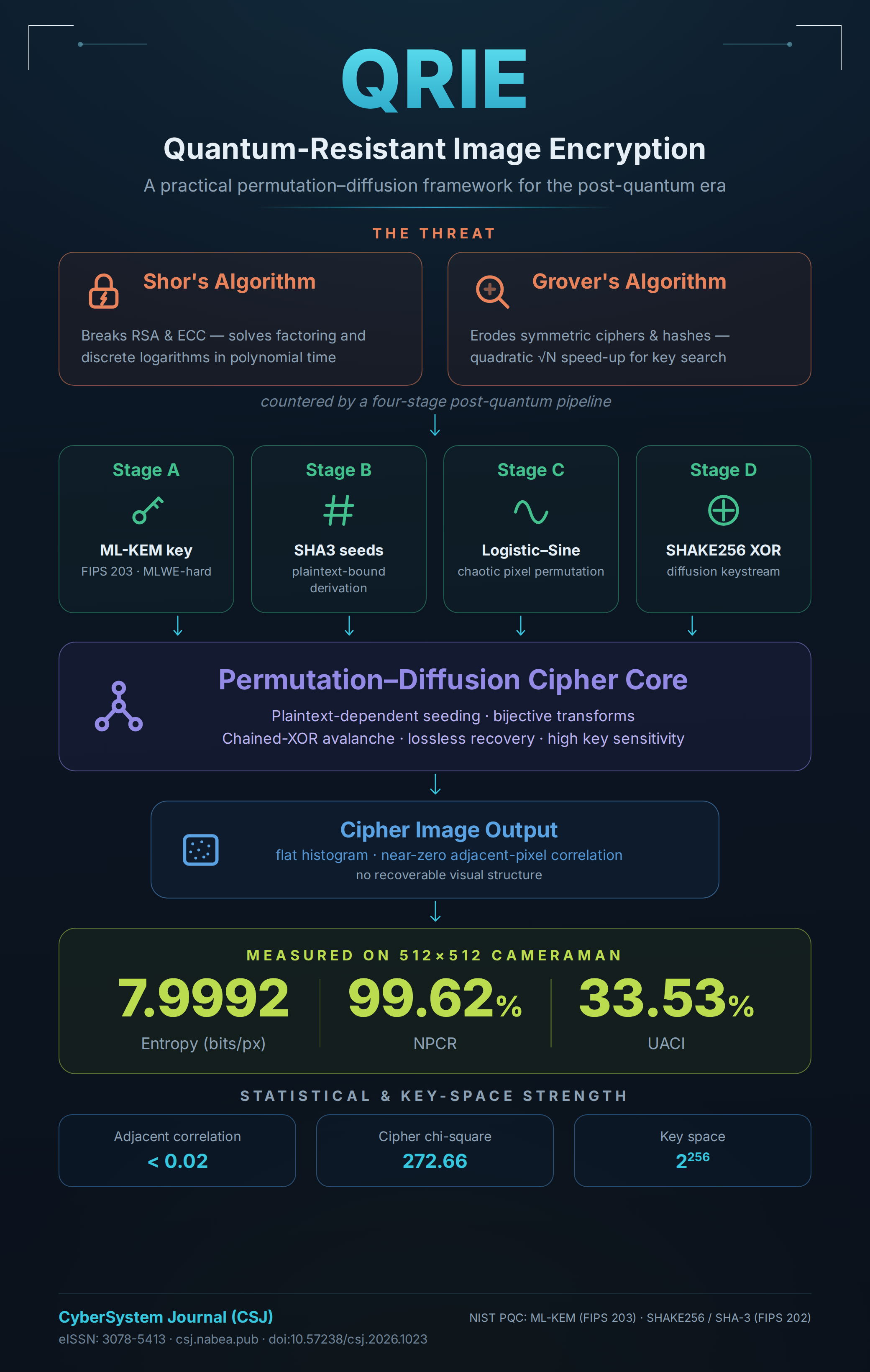
The migration toward quantum computing threatens the cryptographic primitives that secure digital imagery. Shor’s algorithm dismantles the integer-factorization and discrete-logarithm assumptions underlying RSA and ECC, while Grover’s algorithm erodes the effective strength of symmetric ciphers and hash functions. Digital images, owing to their bulk volume, strong inter-pixel correlation, and high redundancy, demand encryption schemes that differ from those designed for text. This paper proposes a Quantum-Resistant Image Encryption (QRIE) framework that combines a chaotic Logistic–Sine permutation stage with a diffusion stage whose keystream is generated from SHAKE256—an extendable-output function of the SHA-3 family and whose session key is established by a NIST-standardized module-lattice key-encapsulation mechanism (ML-KEM, FIPS 203). The plaintext-dependent seeding binds every keystream to the image content, providing resistance to chosen-plaintext and differential attacks. The framework was implemented and evaluated on the standard 512×512 Cameraman benchmark. Measured results show an information entropy of 7.9992 bits/pixel, adjacent-pixel correlation coefficients reduced from above 0.97 to below 0.02, NPCR of 99.62%, UACI of 33.53%, and a cipher-image chi-square of 272.66 (below the 0.05 critical value of 293.25), confirming statistical uniformity. A single-bit change in the key fails to recover any visual information, demonstrating high key sensitivity. The results are consistent with state-of-the-art chaos-based ciphers while additionally inheriting post-quantum key-establishment and keystream generation.
Keywords
Article Details
Copyright (c) 2026 Mustafa Shubber , Armin Rashno (Author)

This work is licensed under a Creative Commons Attribution 4.0 International License.
How to Cite


References
- L. K. Grover, “A fast quantum mechanical algorithm for database search,” in Proc. 28th Annu. ACM Symp. Theory of Computing (STOC), Philadelphia, PA, USA, 1996, pp. 212–219, doi: 10.1145/237814.237866
- P. W. Shor, “Polynomial-time algorithms for prime factorization and discrete logarithms on a quantum computer,” SIAM J. Comput., vol. 26, no. 5, pp. 1484–1509, 1997, doi: 10.1137/S0097539795293172
- National Institute of Standards and Technology, “Module-Lattice-Based Key-Encapsulation Mechanism Standard,” FIPS PUB 203, Aug. 2024, doi: 10.6028/NIST.FIPS.203
- National Institute of Standards and Technology, “Module-Lattice-Based Digital Signature Standard,” FIPS PUB 204, Aug. 2024, doi: 10.6028/NIST.FIPS.204
- National Institute of Standards and Technology, “Stateless Hash-Based Digital Signature Standard,” FIPS PUB 205, Aug. 2024, doi: 10.6028/NIST.FIPS.205
- National Institute of Standards and Technology, “SHA-3 Standard: Permutation-Based Hash and Extendable-Output Functions,” FIPS PUB 202, Aug. 2015, doi: 10.6028/NIST.FIPS.202
- S. Jadoon, L. Pan, S. Huda, and K. H. Khan, “A survey of image encryption schemes: Arnold transformation, chaos, bit-plane extraction and permutation based algorithms,” Multimedia Tools Appl., 2026, doi: 10.1007/s11042-026-21425-0
- R. Amutha and A. V. Phamila, “Chaotic cosine and logistic map based robust image encryption with dual-stage confusion–diffusion architecture,” Sci. Rep., 2026, doi: 10.1038/s41598-026-40337-5
- T. Anujaa, A. F. T. Ali Ahamed, V. Baranwal, V. Thanikaiselvan, S. Subashanthini, C. Sivaranjani Devi, and R. Amirtharajan,“A lightweight multi-round confusion–diffusion cryptosystem for securing images using a modified 5D chaotic system,” Sci. Rep., vol. 15, 2025, doi:10.1038/s41598-025-13290-y
- W. Lu, C. Jin, J. Wang, X. Liu, J. Liu, and Z. Zhai, “A novel image encryption scheme using 3D chaotic maps with Josephus permutation and dynamic diffusion,” J. King Saud Univ. Comput. Inf. Sci., vol. 37, art. 254, 2025, doi: 10.1007/s44443-025-00284-z
- W. Alexan, E. A. Maher, E. Mamdouh, M. Youssef, and N. Ehab, “A chaos-based augmented image encryption scheme for satellite images using Fredkin logic,” Sci. Rep., vol. 15, 2025, doi: 10.1038/s41598-025-22008-z
- D. Sundeep, K. Umadevi, B. P. Bugge, C. Chandrasekhara Sastry, S. Salunkhe, and R. Cep, “Reversible medical image cryptography using spatial XOR-rotation and chaos-driven permutation and diffusion schemes,” Sci. Rep., vol. 16, art.
References
L. K. Grover, “A fast quantum mechanical algorithm for database search,” in Proc. 28th Annu. ACM Symp. Theory of Computing (STOC), Philadelphia, PA, USA, 1996, pp. 212–219, doi: 10.1145/237814.237866
P. W. Shor, “Polynomial-time algorithms for prime factorization and discrete logarithms on a quantum computer,” SIAM J. Comput., vol. 26, no. 5, pp. 1484–1509, 1997, doi: 10.1137/S0097539795293172
National Institute of Standards and Technology, “Module-Lattice-Based Key-Encapsulation Mechanism Standard,” FIPS PUB 203, Aug. 2024, doi: 10.6028/NIST.FIPS.203
National Institute of Standards and Technology, “Module-Lattice-Based Digital Signature Standard,” FIPS PUB 204, Aug. 2024, doi: 10.6028/NIST.FIPS.204
National Institute of Standards and Technology, “Stateless Hash-Based Digital Signature Standard,” FIPS PUB 205, Aug. 2024, doi: 10.6028/NIST.FIPS.205
National Institute of Standards and Technology, “SHA-3 Standard: Permutation-Based Hash and Extendable-Output Functions,” FIPS PUB 202, Aug. 2015, doi: 10.6028/NIST.FIPS.202
S. Jadoon, L. Pan, S. Huda, and K. H. Khan, “A survey of image encryption schemes: Arnold transformation, chaos, bit-plane extraction and permutation based algorithms,” Multimedia Tools Appl., 2026, doi: 10.1007/s11042-026-21425-0
R. Amutha and A. V. Phamila, “Chaotic cosine and logistic map based robust image encryption with dual-stage confusion–diffusion architecture,” Sci. Rep., 2026, doi: 10.1038/s41598-026-40337-5
T. Anujaa, A. F. T. Ali Ahamed, V. Baranwal, V. Thanikaiselvan, S. Subashanthini, C. Sivaranjani Devi, and R. Amirtharajan,“A lightweight multi-round confusion–diffusion cryptosystem for securing images using a modified 5D chaotic system,” Sci. Rep., vol. 15, 2025, doi:10.1038/s41598-025-13290-y
W. Lu, C. Jin, J. Wang, X. Liu, J. Liu, and Z. Zhai, “A novel image encryption scheme using 3D chaotic maps with Josephus permutation and dynamic diffusion,” J. King Saud Univ. Comput. Inf. Sci., vol. 37, art. 254, 2025, doi: 10.1007/s44443-025-00284-z
W. Alexan, E. A. Maher, E. Mamdouh, M. Youssef, and N. Ehab, “A chaos-based augmented image encryption scheme for satellite images using Fredkin logic,” Sci. Rep., vol. 15, 2025, doi: 10.1038/s41598-025-22008-z
D. Sundeep, K. Umadevi, B. P. Bugge, C. Chandrasekhara Sastry, S. Salunkhe, and R. Cep, “Reversible medical image cryptography using spatial XOR-rotation and chaos-driven permutation and diffusion schemes,” Sci. Rep., vol. 16, art.