
Article Sidebar
Main Article Content
Abstract
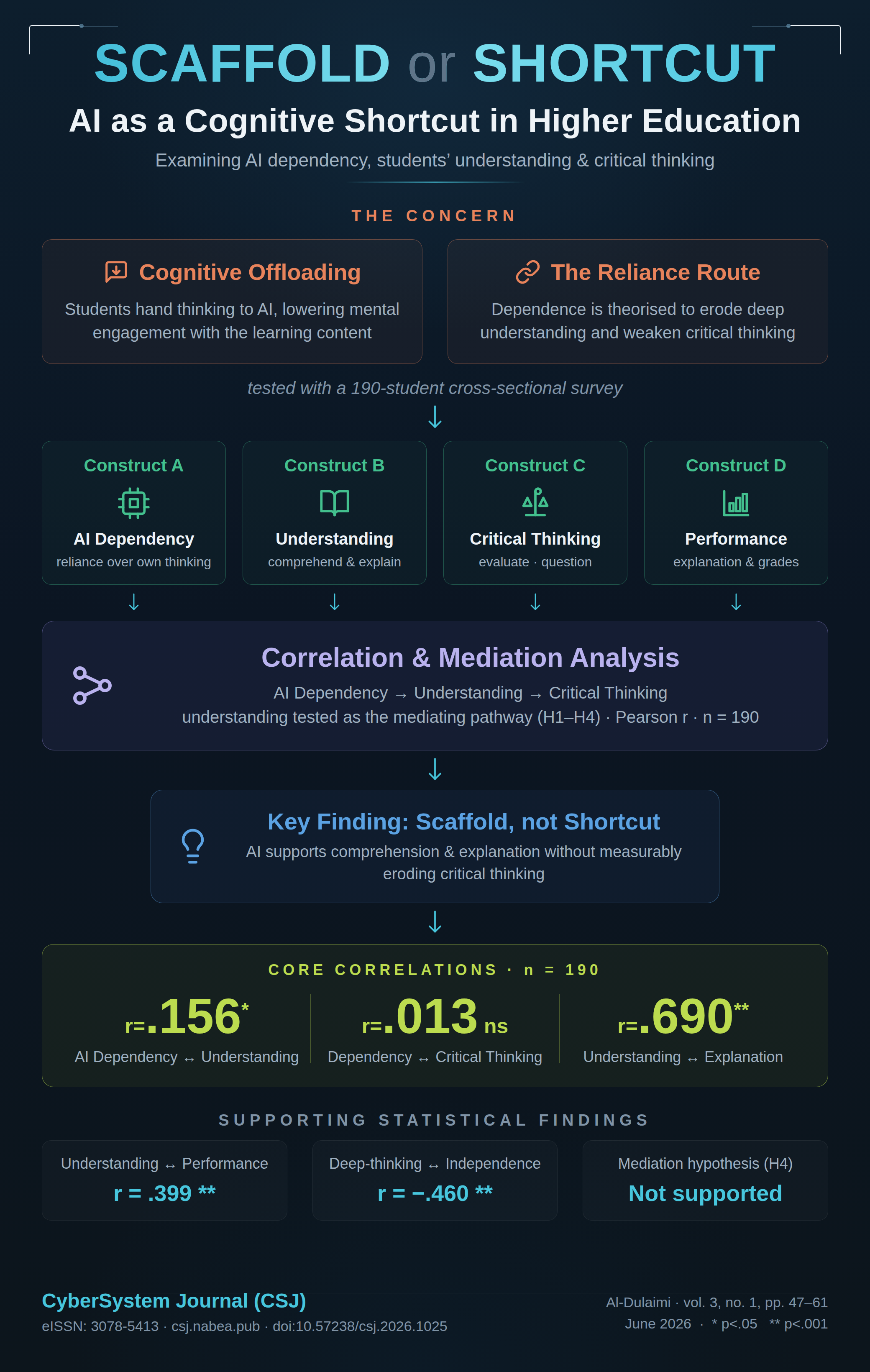
This research papers Studying the impact of artificial intelligence as a pithiness knowledge tool in higher education this research focuses on students exploring although the references of this study the dependency of AI in the academic field, is still limited by Deeping understanding and syllabus. Research cautions on the risk of cognitive dependency. To study this phenomenon a structured questionnaire was adopted as a quantitative approach and was distributed to students of higher education..190 responses were collected to describe the statically analysis to test AI usage, dependency and the Expected educational results The findings revealed that, although there were many tools available to use within AI, students could only understand to a very limited extent. In addition the reliance on AI tools is taken to mean the short cuts rather than Deeping learning and individual thinking. Should display the concept that AI is a shallow knowledge and is centered on the gap between the widely adopted and fruitful learning result.
Keywords
Article Details
Copyright (c) 2026 Suha Al-Dulaimi (Author)

This work is licensed under a Creative Commons Attribution 4.0 International License.
How to Cite


References
- L. Lim et al., "Effects of artificial intelligence utilization on students' cognitive development and critical thinking dispositions at secondary and higher education levels," Int. J. Soc. Sci., vol. 4, pp. 118–129, 2026.
- A. Miller, "The impact of technology dependency in higher education: A critical examination of cognitive, behavioural and societal outcomes," World J. Adv. Res. Rev., vol. 29, no. 3, pp. 1974–1991, 2026, doi: 10.30574/wjarr.2026.29.3.0738
- M. Özer, H. Tanberkan, and M. Perc, "Artificial intelligence threatens critical thinking in education systems," J. Higher Educ. Sci., vol. 15, no. 2, pp. 157–164, Aug. 2025, doi: 10.5961/higheredusci.1747885
- K. R. Menikdiwela, P. Muthukrishnan, P. M. I. Seraj, G. Subramaniam, and W. Meng, "Bibliometric analysis on artificial intelligence and critical thinking skills of higher education students," Asian J. Univ. Educ., vol. 22, no. 1, pp. 1–20, Feb. 2026, doi: 10.24191/ajue.v22i1.001
- D. Conti, G. Romeo, and S. Di Nuovo, "Generative artificial intelligence in higher education: Opportunities, risks, and the future of critical thinking and human reasoning,", 2026, pp. 9–24.
- L. Favero, J.-A. Pérez-Ortiz, T. Käser, and N. Oliver, "Do AI tutors empower or enslave learners? Toward a critical use of AI in education," arXiv, Jul. 2025, doi: 10.48550/arXiv.2507.06878
- R. S. Ridlo, F. S. Iliasu, and S. Ma'rufah, "AI-mediated critical thinking: A double-edged sword in Indonesian higher education," Attaqwa: J. Ilmu Pendidikan Islam, vol. 22, no. 2, pp. 128–138, 2026.
- J. Tian and R. Zhang, "Outsourcing thinking to AI? Focused immersion, AI dependency, and the double-edged impact on critical thinking," Humanit. Soc. Sci. Commun., 2026, doi: 10.1057/s41599-026-07153-8
- M. Maslan and N. Ubaidah, "Artificial intelligence in education and its conditional impact on critical thinking: A systematic literature review," J. Didactical Math., vol. 8, no. 1, pp. 187–203, 2026.
- Y. Li et al., "The improvement or hindrance of the new generation of artificial intelligence: The role of ChatGPT in critical thinking skills," Int. J. Inf. Technol. Syst. Approach, vol. 19, pp. 1–24, 2026.
- Z. Naz, H. M. Baig, and S. Parveen, "Artificial intelligence and the decline of critical thinking: A hidden academic crisis in contemporary education systems," Rev. Educ. Adm. Law, vol. 9, no. 1, pp. 53–65, 2025, doi: 10.47067/real.v9i1.472
- J. Popalia et al., "AI dependency and critical thinking in higher education: A life-course perspective on ethical awareness and algorithmic bias," Artif. Intell. Lifelong Life-Course Educ., vol. 1, pp. 13–23, 2026.
- D. Long et al., "Artificial intelligence in higher education: A systematic review of its impact on student engagement and the mediating role of teaching methods," Front. Educ., vol. 10, 2026.
- M. G. Kibria et al., "Determinants of ChatGPT adoption in higher education: An empirical study on public and private university students in Bangladesh," Glob. Bus. Rev., 2026, doi: 10.1177/09721509261443740
- T. D. Putranto, D. Sofiah, and H. S. Ramadhani, "Understanding university students' learning engagement in AI-supported learning environments: An empirical study," J. Paedagogy, vol. 13, no. 1, pp. 222–232, 2026.
- T. Yuensook, T. Jantakoon, and P. Limpinan, "AI-driven adaptive learning systems in higher education: A systematic review," J. Educ. Learn., vol. 15, p. 117, 2025.
- V. Girish et al., "Harnessing artificial intelligence for smart learning: An empirical study on student academic performance," J. Mark. Soc. Res., vol. 2, pp. 1–11, 2025.
- W. Zhang, B. Chen, and C. Tang, "An empirical study on the impact of generative artificial intelligence-based learning activities on college students' deep learning," Res. Pract. Technol. Enhanc. Learn., vol. 21, p. 028, 2026.
- Y. Chen and H. Wu, "Identifying dominant and heterogeneous factors influencing students' future capabilities under the digital transformation of higher education: A machine learning approach," Interact. Learn. Environ., pp. 1–21, 2026.
- R. Gesnot, "The impact of artificial intelligence on human thought," arXiv, 2025, doi: 10.48550/arXiv.2508.16628.
- N. Rothinam et al., "Systematic literature review on critical thinking in higher education," Edelweiss Appl. Sci. Technol., vol. 9, no. 5, pp. 2046–2063, 2025.
- R. Yavich, "Will the use of AI undermine students independent thinking?" Educ. Sci., vol. 15, no. 6, p. 669, 2025.
- P. Brazão and L. Tinoca, "Artificial intelligence and critical thinking: A case study with educational chatbots," Frontiers Media SA, 2026
- S.-E. Baumeister et al., "Cross-sectional studies: Strengths, limitations, and methodological considerations," J. Periodontal Res., 2026, doi: 10.1111/jre.70063
- C. Maier, J. B. Thatcher, V. Grover, and Y. K. Dwivedi, "Cross-sectional research: A critical perspective, use cases, and recommendations for IS research," Int. J. Inf. Manage., vol. 70, p. 102625, Jun. 2023, doi: 10.1016/j.ijinfomgt.2023.102625
- W. Zhong, J. Luo, and Y. Lyu, "How do personal attributes shape AI dependency in Chinese higher education context? Insights from needs frustration perspective," PLoS ONE, vol. 19, no. 11, p. e0313314, Nov. 2024, doi: 10.1371/journal.pone.0313314
- D. Zhang et al., "Exploring the relationship between AI literacy, AI trust, AI dependency, and 21st century skills in preservice mathematics teachers," Sci. Rep., vol. 15, art. no. 14281, Apr. 2025, doi: 10.1038/s41598-025-99127-0
- S. E. Scholtz, "Sacrifice is a step beyond convenience: A review of convenience sampling in psychological research in Africa," SA J. Ind. Psychol., vol. 47, art. no. a1837, 2021, doi: 10.4102/sajip.v47i0.1837
- A. Kulal, "Cognitive risks of AI: Literacy, trust, and critical thinking," J. Comput. Inf. Syst., pp. 1–13, 2025, doi: 10.1080/08874417.2025.2582050
References
L. Lim et al., "Effects of artificial intelligence utilization on students' cognitive development and critical thinking dispositions at secondary and higher education levels," Int. J. Soc. Sci., vol. 4, pp. 118–129, 2026.
A. Miller, "The impact of technology dependency in higher education: A critical examination of cognitive, behavioural and societal outcomes," World J. Adv. Res. Rev., vol. 29, no. 3, pp. 1974–1991, 2026, doi: 10.30574/wjarr.2026.29.3.0738
M. Özer, H. Tanberkan, and M. Perc, "Artificial intelligence threatens critical thinking in education systems," J. Higher Educ. Sci., vol. 15, no. 2, pp. 157–164, Aug. 2025, doi: 10.5961/higheredusci.1747885
K. R. Menikdiwela, P. Muthukrishnan, P. M. I. Seraj, G. Subramaniam, and W. Meng, "Bibliometric analysis on artificial intelligence and critical thinking skills of higher education students," Asian J. Univ. Educ., vol. 22, no. 1, pp. 1–20, Feb. 2026, doi: 10.24191/ajue.v22i1.001
D. Conti, G. Romeo, and S. Di Nuovo, "Generative artificial intelligence in higher education: Opportunities, risks, and the future of critical thinking and human reasoning,", 2026, pp. 9–24.
L. Favero, J.-A. Pérez-Ortiz, T. Käser, and N. Oliver, "Do AI tutors empower or enslave learners? Toward a critical use of AI in education," arXiv, Jul. 2025, doi: 10.48550/arXiv.2507.06878
R. S. Ridlo, F. S. Iliasu, and S. Ma'rufah, "AI-mediated critical thinking: A double-edged sword in Indonesian higher education," Attaqwa: J. Ilmu Pendidikan Islam, vol. 22, no. 2, pp. 128–138, 2026.
J. Tian and R. Zhang, "Outsourcing thinking to AI? Focused immersion, AI dependency, and the double-edged impact on critical thinking," Humanit. Soc. Sci. Commun., 2026, doi: 10.1057/s41599-026-07153-8
M. Maslan and N. Ubaidah, "Artificial intelligence in education and its conditional impact on critical thinking: A systematic literature review," J. Didactical Math., vol. 8, no. 1, pp. 187–203, 2026.
Y. Li et al., "The improvement or hindrance of the new generation of artificial intelligence: The role of ChatGPT in critical thinking skills," Int. J. Inf. Technol. Syst. Approach, vol. 19, pp. 1–24, 2026.
Z. Naz, H. M. Baig, and S. Parveen, "Artificial intelligence and the decline of critical thinking: A hidden academic crisis in contemporary education systems," Rev. Educ. Adm. Law, vol. 9, no. 1, pp. 53–65, 2025, doi: 10.47067/real.v9i1.472
J. Popalia et al., "AI dependency and critical thinking in higher education: A life-course perspective on ethical awareness and algorithmic bias," Artif. Intell. Lifelong Life-Course Educ., vol. 1, pp. 13–23, 2026.
D. Long et al., "Artificial intelligence in higher education: A systematic review of its impact on student engagement and the mediating role of teaching methods," Front. Educ., vol. 10, 2026.
M. G. Kibria et al., "Determinants of ChatGPT adoption in higher education: An empirical study on public and private university students in Bangladesh," Glob. Bus. Rev., 2026, doi: 10.1177/09721509261443740
T. D. Putranto, D. Sofiah, and H. S. Ramadhani, "Understanding university students' learning engagement in AI-supported learning environments: An empirical study," J. Paedagogy, vol. 13, no. 1, pp. 222–232, 2026.
T. Yuensook, T. Jantakoon, and P. Limpinan, "AI-driven adaptive learning systems in higher education: A systematic review," J. Educ. Learn., vol. 15, p. 117, 2025.
V. Girish et al., "Harnessing artificial intelligence for smart learning: An empirical study on student academic performance," J. Mark. Soc. Res., vol. 2, pp. 1–11, 2025.
W. Zhang, B. Chen, and C. Tang, "An empirical study on the impact of generative artificial intelligence-based learning activities on college students' deep learning," Res. Pract. Technol. Enhanc. Learn., vol. 21, p. 028, 2026.
Y. Chen and H. Wu, "Identifying dominant and heterogeneous factors influencing students' future capabilities under the digital transformation of higher education: A machine learning approach," Interact. Learn. Environ., pp. 1–21, 2026.
R. Gesnot, "The impact of artificial intelligence on human thought," arXiv, 2025, doi: 10.48550/arXiv.2508.16628.
N. Rothinam et al., "Systematic literature review on critical thinking in higher education," Edelweiss Appl. Sci. Technol., vol. 9, no. 5, pp. 2046–2063, 2025.
R. Yavich, "Will the use of AI undermine students independent thinking?" Educ. Sci., vol. 15, no. 6, p. 669, 2025.
P. Brazão and L. Tinoca, "Artificial intelligence and critical thinking: A case study with educational chatbots," Frontiers Media SA, 2026
S.-E. Baumeister et al., "Cross-sectional studies: Strengths, limitations, and methodological considerations," J. Periodontal Res., 2026, doi: 10.1111/jre.70063
C. Maier, J. B. Thatcher, V. Grover, and Y. K. Dwivedi, "Cross-sectional research: A critical perspective, use cases, and recommendations for IS research," Int. J. Inf. Manage., vol. 70, p. 102625, Jun. 2023, doi: 10.1016/j.ijinfomgt.2023.102625
W. Zhong, J. Luo, and Y. Lyu, "How do personal attributes shape AI dependency in Chinese higher education context? Insights from needs frustration perspective," PLoS ONE, vol. 19, no. 11, p. e0313314, Nov. 2024, doi: 10.1371/journal.pone.0313314
D. Zhang et al., "Exploring the relationship between AI literacy, AI trust, AI dependency, and 21st century skills in preservice mathematics teachers," Sci. Rep., vol. 15, art. no. 14281, Apr. 2025, doi: 10.1038/s41598-025-99127-0
S. E. Scholtz, "Sacrifice is a step beyond convenience: A review of convenience sampling in psychological research in Africa," SA J. Ind. Psychol., vol. 47, art. no. a1837, 2021, doi: 10.4102/sajip.v47i0.1837
A. Kulal, "Cognitive risks of AI: Literacy, trust, and critical thinking," J. Comput. Inf. Syst., pp. 1–13, 2025, doi: 10.1080/08874417.2025.2582050